How to Remember What You Study: The Amitkr Method (COR3)
The 5-step loop I use to remember what I study: comprehend, organise, remember, retrieve and revise. COR3 for short.

Have you ever spent two hours on a chapter, closed the book feeling confident, and found a week later that almost NOTHING was left?
You read it. You understood it. Maybe you even read it twice. And still, when you tried to recall it, all you got was a blur.
If this sounds familiar, the problem is not your memory. The problem is HOW you study. Reading the same chapter again and again is the slowest way to remember it.
In this article, I’ll show you the method which I call the Amitkr Method (COR3). This is the loop I have been using for every chapter or topic in my studies.
QUICK ANSWER
Here is how to remember what you study for UPSC: don’t read a chapter again and again. Run every topic through five steps: Comprehend it, Organise it into one page, Remember the hard facts with a memory hook, Retrieve it from memory without looking, and Revise it on days 1, 3, 7, 16 and 30. That is the Amitkr Method, or COR3 for short.
Why Do We Forget What We Study?
We forget what we study because new information first sits in short-term memory, and it fades within days unless we use it again.
When you read a chapter, your brain holds it for a short time. To move it into long-term memory (LTM), your brain needs a reason: you have to understand it, connect it to what you already know, and bring it back again and again. Without that, most of it fades within days.
Here is the trap. Re-reading feels like learning. Every time you read the page again, it looks familiar, and you think, “I know this.” But recognising a page is NOT the same as recalling it in the exam hall, with no book in front of you.
So the answer is not to study more hours. It is to study in a way that moves information from short-term memory (STM) to long-term memory (LTM), and keeps it there. That is exactly what the five steps below are designed to do.
What Is the Amitkr Method (COR3)?
The Amitkr Method is a five-step learning and revision system that helps you understand information, organise it, remember difficult facts and retain everything through regular practice.
Instead of reading the same chapter repeatedly, each chapter moves through five steps:
- Comprehend – Understand what you are studying.
- Organise – Convert the information into structured notes.
- Remember – Use memory techniques to retain difficult facts.
- Retrieve – Recall information without looking at your notes.
- Revise – Revisit the information at carefully spaced intervals.
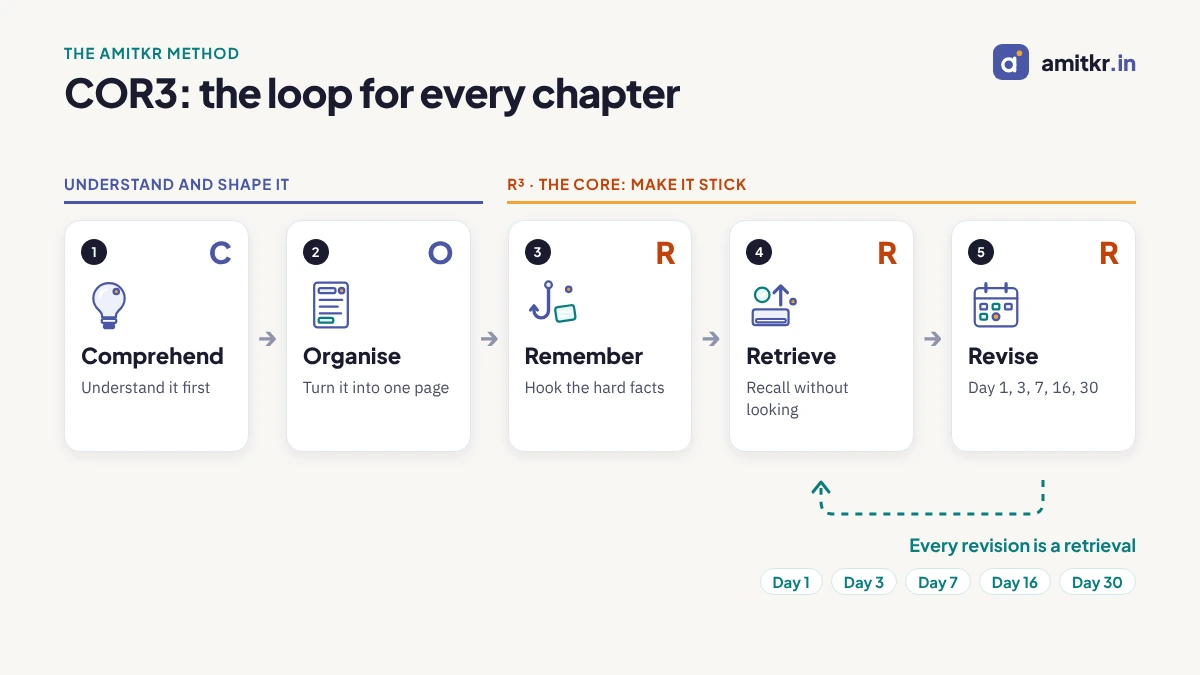
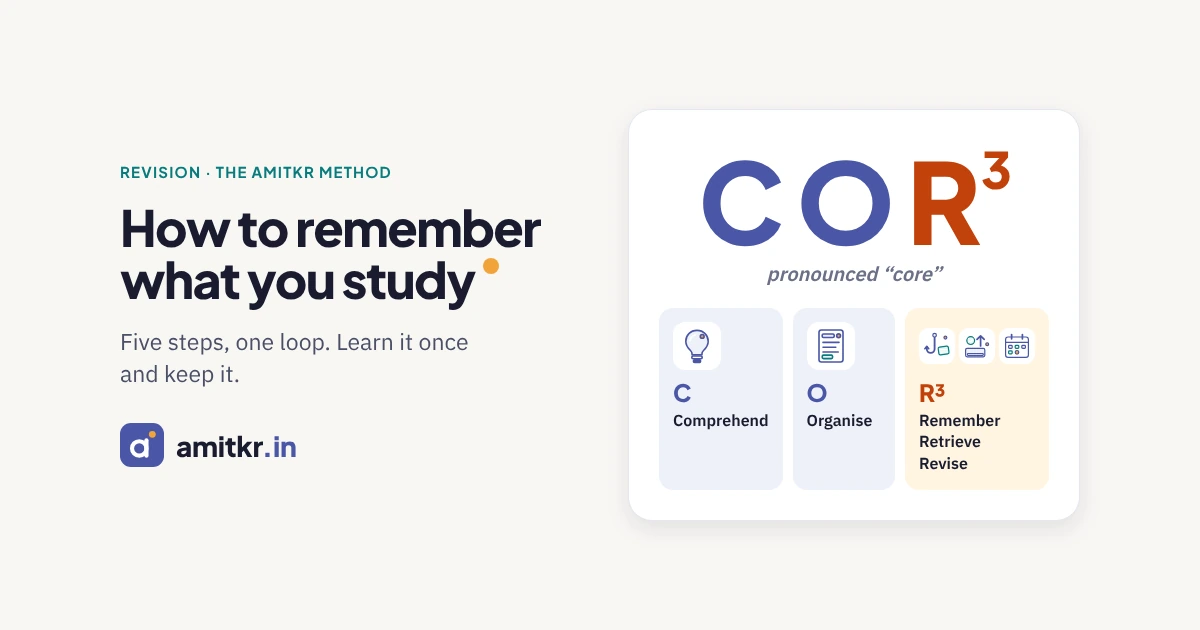
MEMORY HOOK: COR3 (PRONOUNCED “CORE”)
I use a simple memory code to remember these steps:
- C – Comprehend
- O – Organise
- R3 – Remember → Retrieve → Revise
The three Rs form the core of the system. Think of it this way: first, you store the information (Remember), then you pull it out (Retrieve), and finally, you keep it fresh (Revise).
Each step has a specific purpose. Skipping one can weaken the entire process. Let’s look at them one by one.
Step 1: Comprehend Before You Memorise
The first rule of the Amitkr Method is simple: understand first, memorise later.
Before trying to remember anything, spend some time understanding what you are studying. Ask yourself four questions:
- What: What is this concept about?
- Why: Why does it exist? What problem does it solve?
- How: How does it work?
- Connection: How does it relate to something I already know?
For example, before memorising the Fundamental Rights, understand why they were included in the Constitution, what purpose they serve and how they protect citizens.
Once you understand the underlying idea, individual facts become easier to remember.
Your goal at this stage is NOT to memorise the chapter. It is to understand what the chapter is trying to teach you. It may take you one or more readings. So, focus on understanding, not on the number of readings you have completed.
WHY IT WORKS
Memory researchers found that the deeper you process something, the longer you remember it. Thinking about what a fact means leaves a stronger memory trace than just reading its words (Craik and Lockhart, 1972).
WHERE AI HELPS
If you find a topic difficult to understand, ask an AI tool to explain a difficult paragraph, compare two similar concepts or provide real-life examples. However, don’t blindly accept everything AI tells you. Use it to understand the topic, then cross-check important information with your textbook or a reliable source.
Step 2: Organise It Into One Page
Now that you understand the topic, the next step is to organise the information.
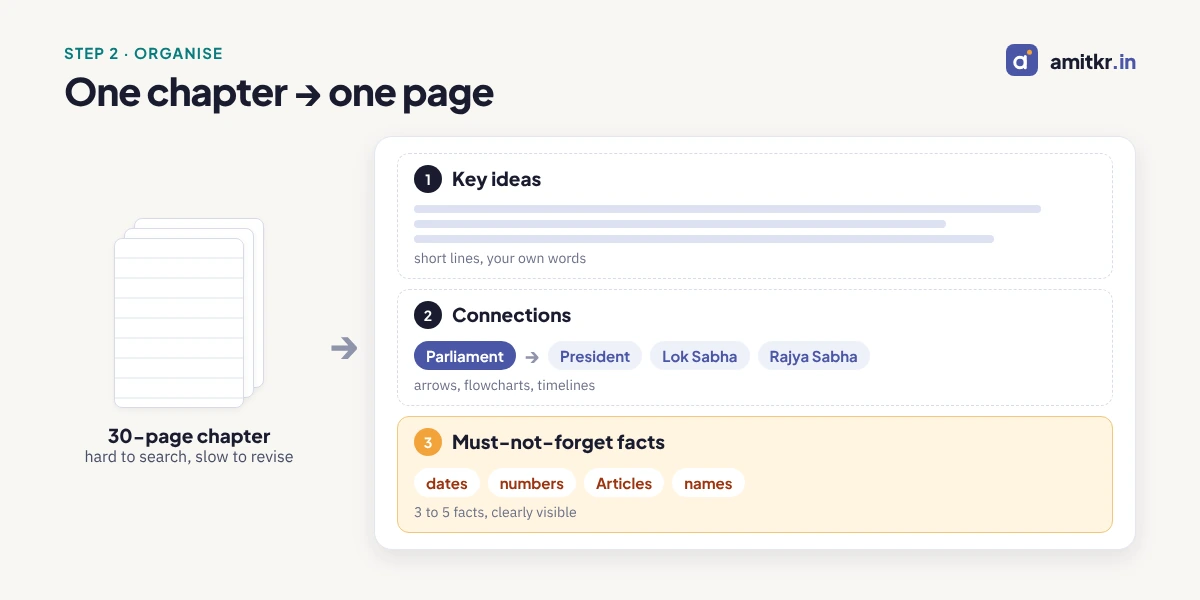
Think about what happens when you finish reading a 30-page chapter. You might remember the broad idea, but where do you find a particular definition, an important date or the connection between two concepts? You have to go through the entire chapter again.
This is where organised notes come into the picture. Instead of trying to remember everything from the textbook, convert the chapter into a structured one-page note. The idea is simple: bring the most important information together in one place.
Your one-page note should contain three things:
1. Key ideas
Identify the main concepts and important points discussed in the chapter. Write short explanations in your own words.
Don’t copy entire paragraphs. Try to filter out the important points from the fillers (words or sentences) in the chapter. This ability will come to you naturally once you build the reading habit of Step 1.
2. Connections
Show how different concepts relate to each other. You can use arrows, flowcharts, diagrams, timelines or simple visual structures.
For example, while studying the Indian Parliament, you can connect: Parliament → President + Lok Sabha + Rajya Sabha. Then organise the functions, composition and powers under the relevant headings.
3. Important facts
Identify the three to five facts that you absolutely cannot afford to forget. These could be important dates, numbers, names, Articles, constitutional amendments or definitions. Keep them clearly visible.
Why one-page notes?
A well-organised note reduces the effort required to navigate a large chapter. Instead of going through 30 pages every time you revise, you can quickly revisit the main concepts and their connections. It also helps you see what you know and what you still need to work on.
Remember, the purpose is NOT to squeeze every sentence from a textbook onto one page. It is to create a compact picture of the chapter that makes revision easier.
Don’t confuse making beautiful notes with making useful notes. Your notes should help you remember, not become another time-consuming project.
Want to learn how to create effective one-page notes? I’ll explain the complete process, with examples, in my upcoming article on one-page note-making.
WHY IT WORKS
Our brain doesn’t store every piece of information as an isolated fact. It connects new information with things we already know. With a clear structure, it is easier to find the information again when we need it.
WHERE AI HELPS
Write the note yourself first. Then paste the chapter’s headings and your note into an AI tool and ask, “Which key idea or connection did I miss?” Add only what you agree with.
Step 3: Remember the Hard Facts with a Memory Hook
By now, you understand the topic and have organised the important information. But some facts are still difficult to remember, such as lists, numbers, names, dates and sequences.
You might understand the functions of the Election Commission perfectly well, but remembering the exact sequence of constitutional provisions or a long list of commissions can be challenging.
This is where memory techniques become useful. Instead of repeatedly reading these facts, attach a memory hook to them. A memory hook is an association that helps your brain recall otherwise difficult information.
There are several ways to create one: acronyms, stories with visual associations, the Memory Palace and more. You can explore some of them in my dedicated articles:
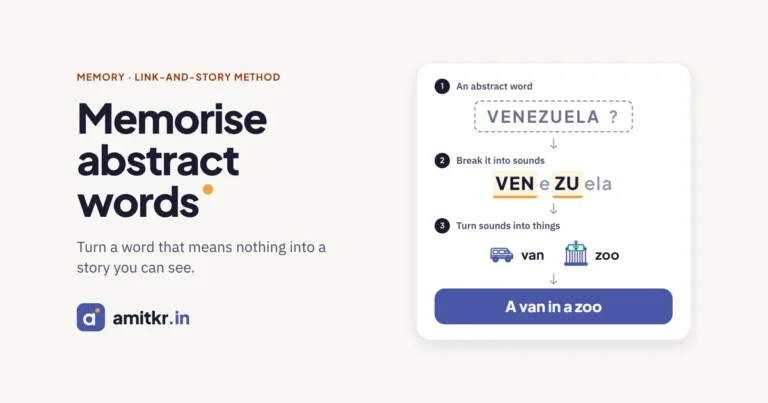
- How to Memorise Abstract or Random Words
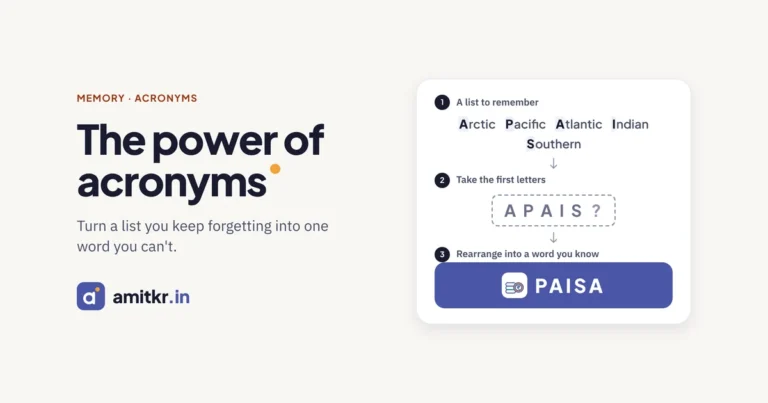
- Unleashing the Power of Acronyms for Memorization
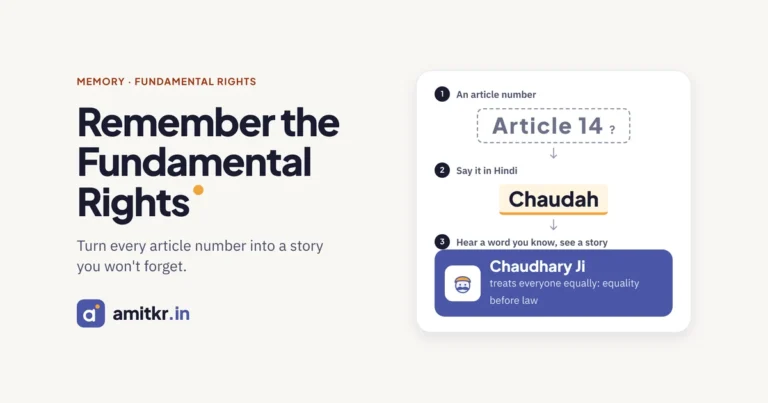
- How to Remember the Fundamental Rights (a full worked example)
- How to Remember Lists Using Mnemonics (coming soon)
- How to Use the Memory Palace Technique (coming soon)
These are just a few techniques. There are many more that I will teach in future articles.
An important rule: DON’T create a memory hook for everything. If you understand a concept and can remember it naturally, there is no need to complicate it. Use memory techniques only for information that genuinely needs them, i.e. information that refuses to stick.
For example, you don’t need a special mnemonic to remember that the President appoints the Prime Minister. But you might need one for a long list of constitutional bodies or important Articles.
WHY IT WORKS
Abstract facts (a number, an Article, a name) have nothing to hold on to. A memory hook links them to a picture or story you already know, and your brain remembers pictures and stories far more easily than abstract facts.
WHERE AI HELPS
If you are stuck, ask AI for three hook ideas and pick or change one. But try on your own first. A hook you make yourself sticks better than one you are given.
Step 4: Retrieve It Without Looking
This is perhaps the most important step of the entire method.
Imagine – you have studied a chapter for two hours. You understand the concepts, you have prepared your one-page note and created mnemonics for the difficult facts.
Now close your book.
Can you explain what you just studied? Can you write down the important points without looking at your notes? If not, you need more practice retrieving the information.
Most students spend a lot of time reading and re-reading their notes. But reading something repeatedly creates a feeling of familiarity. You start thinking, “I know this topic.” However, recognising information when you see it is different from recalling it when you need it.
This is where Active Recall comes in. Instead of looking at the information, you bring it out of your memory. Research backs this up: in a well-known study, students who recalled a passage from memory remembered it better a week later than students who simply re-read it.
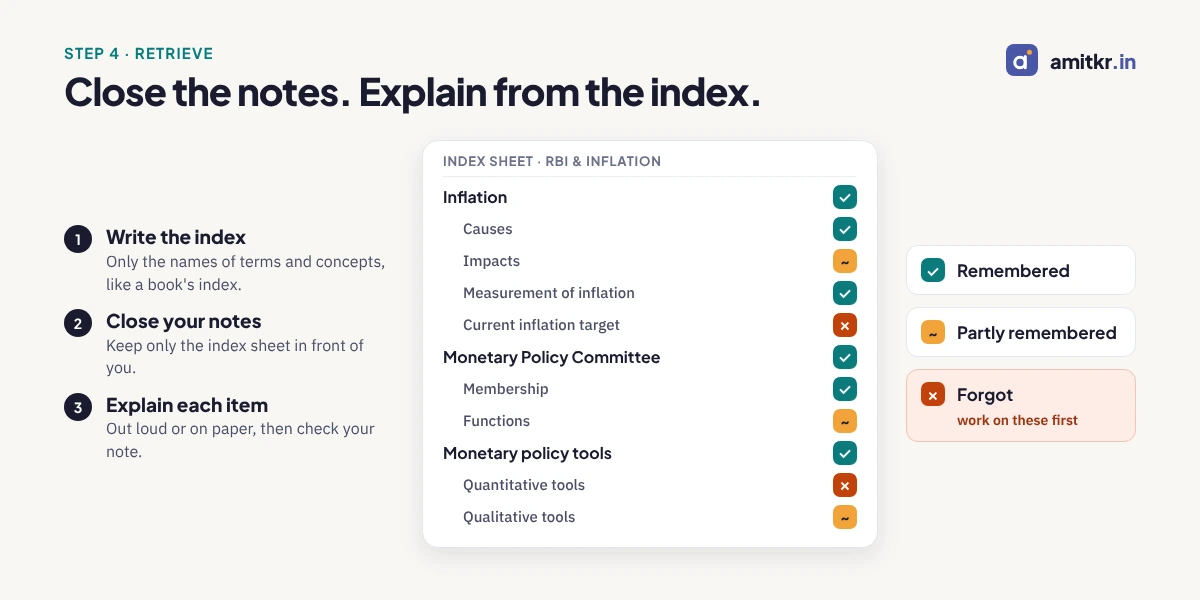
Here is a simple way to do it, using an index note:
- Take a blank sheet of paper. From your one-page note, write down only the names of the terms and concepts, just like the index of a book.
- Close your notes. Keep only the index paper in front of you.
- Go down the index and explain each term or concept, out loud or on paper.
You’ll immediately identify three things:
- What you remembered correctly.
- What you partially remembered.
- What you completely forgot.
Pay special attention to the third category. These are the areas that need more work.
WHY IT WORKS
Every time you pull a fact out of memory, the path to it gets stronger. This is called the testing effect: recalling beats re-reading for long-term memory, even though re-reading feels easier.
WHERE AI HELPS
Paste your one-page note into an AI tool and ask it to quiz you, one question at a time. Answer from memory BEFORE you look at anything.
Step 5: Revise on Day 1, 3, 7, 16 and 30
You have understood the topic, organised your notes, memorised the difficult facts and tested yourself. Are you done?
Not yet.
Even information that you recalled successfully today can become difficult to remember after a few days. This is a natural part of how human memory works. If you don’t revisit information, your ability to recall it slowly weakens.
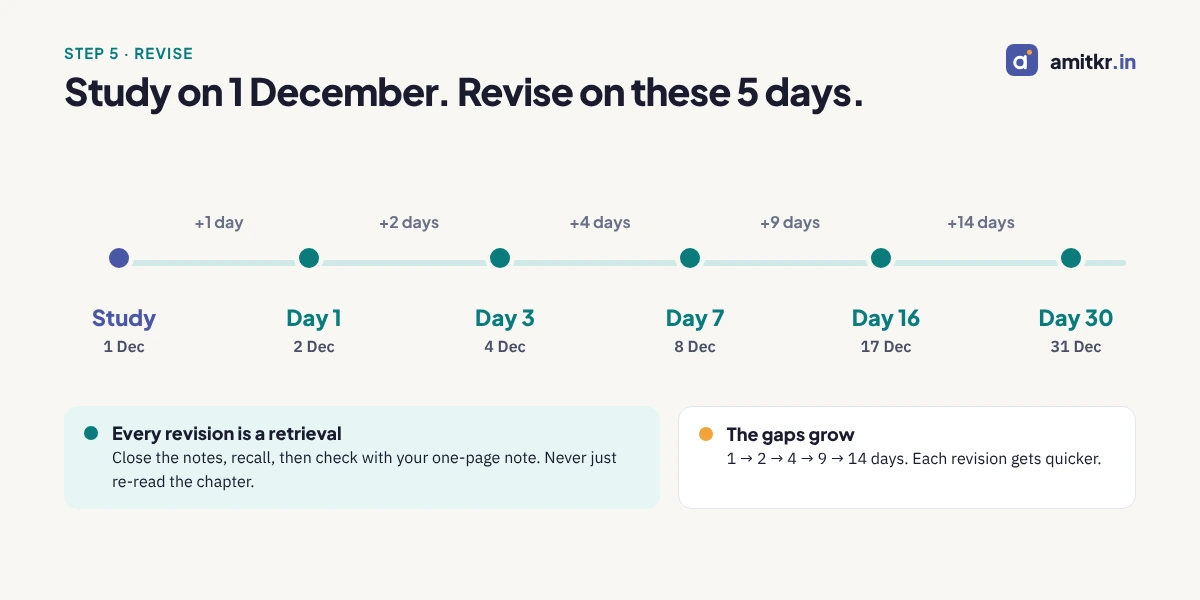
This is why the final step of the Amitkr Method is spaced repetition. Instead of revising everything every day, revisit the information at gradually increasing intervals:
| Revision | When to revise |
|---|---|
| First revision | Day 1 |
| Second revision | Day 3 |
| Third revision | Day 7 |
| Fourth revision | Day 16 |
| Fifth revision | Day 30 |
Let’s say you study the Fundamental Rights on 1 December. Your revision schedule would look like this:
- 2 December – First revision
- 4 December – Second revision
- 8 December – Third revision
- 17 December – Fourth revision
- 31 December – Fifth revision
The gaps become longer each time.
What should you do during revision?
Revision does NOT mean opening your textbook and reading the same chapter again. Every revision should involve retrieval.
Start by closing your notes and trying to recall the important concepts. Then use your one-page note to check what you missed. If you created mnemonics for difficult facts, test yourself on those too. This way, every revision becomes a chance to strengthen your memory.
WHY IT WORKS
Spreading your revision over days and weeks (spaced or distributed practice) is one of only two study techniques that a major review of learning research rated “high utility”; the other was practice testing (Dunlosky and colleagues, 2013).
WHERE AI HELPS
Ask AI to make a fresh set of questions from your note for each revision, so you don’t just memorise the same questions. Keep the dates in your revision tracker, not in your head.
Use the revision tracker
Keeping track of revision dates can become difficult, especially when you are studying several subjects and chapters at the same time. That’s why I recommend using a revision tracker.
My study toolkit includes a simple revision schedule based on the Day 1, 3, 7, 16 and 30 cycle. It helps you keep track of what you have studied, when you need to revise it and which topics are pending.
Explore the Amitkr Study Toolkit →
COR3 in Action: How Does RBI Control Inflation?
Let’s put the entire Amitkr Method into practice.
For this example, we’ll take a topic that often appears in Economy: How does the Reserve Bank of India control inflation through monetary policy? Instead of simply reading an economics textbook, let’s process this topic through all five steps.
Step 1: Comprehend
First, understand the basic idea.
What is inflation? Inflation refers to an increase in the general price level of goods and services.
Imagine – there is too much money chasing too few goods. People have more money to spend, but the supply of goods hasn’t increased at the same pace. As a result, sellers can charge higher prices.
Now, where does the RBI come into the picture? The Reserve Bank of India uses monetary policy to influence the amount of money and credit in the economy. Its objective is to maintain price stability while keeping economic growth in mind.
In simple words, when inflation is too high, the RBI can make borrowing more expensive to reduce spending and demand. When inflation is low and economic activity needs support, it can make borrowing cheaper to encourage spending and investment.
That’s the basic idea. Re-read it if you don’t understand it in one go. You can also take the help of AI to get explanations.
Step 2: Organise
Now convert the topic into a one-page note. You can organise the entire topic under four headings:
1. What is inflation?
A rise in the general price level. Causes: too much demand (demand-pull) or rising costs of production (cost-push). Impacts: money buys less, savings lose value, and the poor are hit hardest.
2. Who decides?
The Monetary Policy Committee (MPC) is a statutory body, set up in 2016 under the RBI Act, 1934, that decides the policy repo rate needed to keep inflation close to the target.
- Membership: 6 members. 3 from the RBI (the Governor as chairperson, the Deputy Governor in charge of monetary policy, and one RBI officer) and 3 external members appointed by the Central Government.
- Functions: sets the repo rate at its meetings (at least four a year). Decisions are by majority; in a tie, the Governor has a casting vote.
3. What is the target?
Inflation measured through the Consumer Price Index (CPI). India’s inflation target is 4% (retained till March 2031):
- Upper tolerance limit: 6%
- Lower tolerance limit: 2%
4. What tools does the RBI use?
Organise the tools into two broad categories.
Quantitative tools – these influence the overall availability and cost of credit:
- Repo Rate
- Standing Deposit Facility (SDF) – replaced the Reverse Repo Rate as the floor of the policy corridor in 2022
- Marginal Standing Facility (MSF)
- Cash Reserve Ratio (CRR)
- Statutory Liquidity Ratio (SLR)
- Open Market Operations (OMO)
Qualitative tools – these influence how credit is distributed or used in specific sectors. Examples include:
- Selective Credit Controls
- Margin Requirements
- Moral Suasion
You now have the basic structure of the entire topic on one page. Your structure may be different. What matters is that you put down the important concepts and points in your note in a structured manner.
Step 3: Remember
Some information is easy to understand but difficult to remember. For this topic, focus on the facts that need deliberate memorisation. For example, MPC composition: remember the number 6.
MEMORY HOOK
The MPC comes into action when the economy gets SICK. Sick sounds like SIX (6). Six members of the MPC come together to treat the sick economy.
This simple association makes a boring number suddenly interesting.
Similarly, if you find it hard to remember other facts, such as the inflation target or the monetary policy tools, you can create a memory hook based on your own knowledge base. You can take the help of AI, but I highly recommend trying on your own. Personalised memory hooks work better.
Remember, you don’t need to create a mnemonic for every definition or explanation. Focus on the facts that are difficult to recall.
Step 4: Retrieve
Close your textbook and your one-page note. Now try to explain the terms and concepts from your index note. The index note should look like this:
- Inflation
- Causes
- Impacts
- Measurement of inflation
- Current inflation target
- Monetary Policy Committee
- Membership
- Functions
- Monetary policy tools
- Quantitative tools
- Qualitative tools
Once you’re done, compare your answers with your notes. Identify the gaps and work on them.
Step 5: Revise
Finally, add this topic to your revision tracker. Revision schedule: Day 1, 3, 7, 16 and 30.
As you move through this schedule, you will notice that your revision time decreases significantly. Also, you didn’t need to read the same chapter five times.
You understood it once, organised it, memorised the difficult facts and then strengthened your memory through retrieval and spaced revision.
That’s the Amitkr Method in action. The goal is not to study more. It is to remember more of what you study.
EXAM ANGLE (UPSC/BPSC)
Prelims often tests the facts in this note directly: how many members the MPC has, the inflation target and its band, and which tool does what (for example, which rate is the floor of the corridor). In Mains, the same one-page note gives you the structure for an answer on inflation targeting: who decides, the target, the tools, and how well it has worked.
Common Mistakes When Studying for UPSC
The most common mistake is treating re-reading as revision. Here are the ones to avoid:
COMMON MISTAKES
- Re-reading instead of recalling. It feels productive, but it only builds familiarity.
- Making notes longer than the book. A one-page note should be short enough to revise in minutes.
- Making a memory hook for everything. Save hooks for facts that refuse to stick.
- Hooking numbers that keep changing. Don’t build a hook around the current repo rate; it changes every few months. Hook stable facts, like the MPC’s 6 members.
- Revising only the night before the exam. Spaced revision works because the gaps are spread out.
- Letting AI do the remembering. AI can explain and quiz you, but the recall has to happen in YOUR head.
Test Yourself: How Well Do You Remember This Post?
Don’t scroll up. Try to answer each question from memory first, then click to check.
How can I remember what I study for UPSC?
Run every topic through five steps: comprehend it, organise it into one page, put a memory hook on the hard facts, recall it without looking, and revise it on a spaced schedule. This is the Amitkr Method, or COR3.
Why do I forget what I study so quickly?
New information sits in short-term memory and fades within days unless you use it. Re-reading feels familiar but does not train your brain to pull the fact out again.
Is re-reading notes a good way to revise?
Not on its own. Recalling a topic from memory before you check your notes builds stronger long-term memory than reading it again.
What is active recall?
Active recall means closing the book and bringing a topic back from memory, by writing, speaking or answering questions, before you check your notes.
How often should I revise a topic for UPSC?
Revise on a growing gap: on day 1, 3, 7, 16 and 30 after you first study it. Each revision should be a recall, not a re-read.
What does COR3 stand for?
Comprehend, Organise, and the three Rs: Remember, Retrieve and Revise. It is pronounced “core”.
Now, It’s Your Turn!
Pick ONE chapter you studied this week. Run it through COR3: comprehend it, make a one-page note, hook only the facts that won’t stick, write an index and recall from it, and add it to your revision tracker.
Follow this method intently for at least two weeks. By the end of those two weeks, you’ll start noticing the difference in how you learn, recall and retain information.
To make Step 5 easy, grab my free study toolkit. It includes the Day 1, 3, 7, 16 and 30 revision tracker and a weekly planner.
Get the free Memory + AI Study Toolkit
A memory techniques cheat sheet, 25 AI study prompts, a one-page note template, a revision tracker and a weekly planner. One printable PDF, free.
See you in the next one.