How to Memorise the Fundamental Rights (Articles 12–35)
Turn each article number into a story: a simple Hindi-number method to remember the Fundamental Rights, worked out for Articles 14–22.

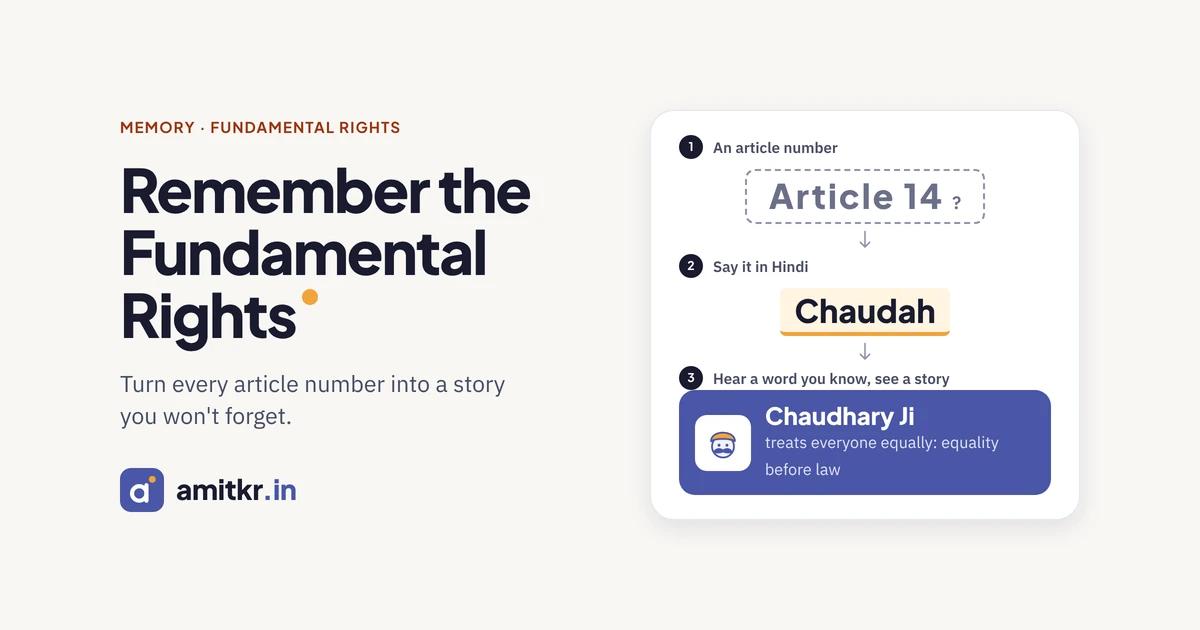
Table of Contents
Introduction
Ask any BPSC or UPSC aspirant to name the Fundamental Rights, and they will probably remember most of them. But ask them which Article deals with which right, and things get confusing very quickly.
Is equality before law under Article 14 or 15? Does Article 16 deal with untouchability or equal opportunity in public employment? And what about Article 17? The numbers start getting mixed up, even when you have revised them several times.
You are not alone. Every aspirant faces this. The problem isn’t that these Articles are difficult to understand. It’s that their numbers are difficult to remember. Part III of our Constitution runs from Article 12 to Article 35, and the numbers look almost the same. Numbers are abstract. They mean nothing to our mind on their own, so they don’t stick.
In this post, I will share the method that would help you remember which right sits behind which article number. We will work through it in detail for the first two groups, Right to Equality (Articles 14–18) and Right to Freedom (Articles 19–22).
QUICK ANSWER
Fundamental Rights are in Part III of the Constitution (Articles 12–35). There are six: Right to Equality (14–18), Right to Freedom (19–22), Right against Exploitation (23–24), Right to Freedom of Religion (25–28), Cultural and Educational Rights (29–30) and Right to Constitutional Remedies (32). To remember them, learn the six groups first, then link each article number’s Hindi name to a similar-sounding word and a small story.
Why Are Fundamental Rights So Hard to Remember?
They are hard to remember because the article numbers are abstract, and they all look alike. Let’s understand why.
When you read “Article 17 – Abolition of Untouchability”, it goes into your Short-Term Memory (STM). If you don’t revisit it, it is lost within a day or two. Reading it again and again does push it into Long-Term Memory (LTM), but it takes a lot of time and effort.
There are two problems here:
- The numbers mean nothing. “17” has no picture, no story. Your mind has nothing to hold on to.
- The numbers are close to each other. 14, 15, 16, 17 and 18 sit side by side. So when you try to recall one, the others get mixed up with it.
In my post How to Memorise Abstract or Random Words, we learned one fundamental principle: our mind easily remembers things that are linked with something we already know, especially when they are part of a story. That is why you remember scenes from your favourite movie but forget a random word.
We will use the same principle here. We will turn every abstract article number into something familiar and give it a story.
How Many Fundamental Rights Are There?
There are six Fundamental Rights in the Indian Constitution. Before you memorise any single article, first fix these six groups in your mind. Think of them as six rooms of a house. Each article lives in one room.
| # | Fundamental Right | Articles |
|---|---|---|
| 1 | Right to Equality | 14–18 |
| 2 | Right to Freedom | 19–22 |
| 3 | Right against Exploitation | 23–24 |
| 4 | Right to Freedom of Religion | 25–28 |
| 5 | Cultural and Educational Rights | 29–30 |
| 6 | Right to Constitutional Remedies | 32 |
You only need to remember where each room begins: 14, 19, 23, 25, 29 and 32.
What about the seventh right you may have read about somewhere? The Right to Property was originally a Fundamental Right. The 44th Amendment (1978) removed it from Part III. Today it is a legal right under Article 300A. So the answer to “how many Fundamental Rights are there?” is SIX, not seven.
The Method: Turn Each Article Number into a Story
Here is the method. For each article number, we connect its Hindi name to a similar-sounding word which sticks better to memory. Then we make a small story that links that word to the right.
It works in three steps:
- Say the number in Hindi. 14 becomes Chaudah, 15 becomes Pandrah, and so on. We think in Hindi numbers since childhood, so they come to mind faster.
- Find a similar-sounding word you already know. Chaudah sounds like Chaudhary. Pandrah sounds like Pandal. Now the abstract number has become a picture.
- Make a small story that joins the word with the right. The Chaudhary treats everyone equally, so Article 14 is Equality before law.
This is exactly what we did with VENEZUELA (Van in a Zoo) and CARACAS (Car full of Cash). Only this time we are breaking up numbers instead of words.
One rule before we start: DO NOT just read the stories. Close your eyes for a few seconds and SEE each scene. The more clearly you see it, the longer it stays.
Let’s dive in.
Worked Example 1: Right to Equality (Articles 14–18)
The Right to Equality covers Articles 14 to 18. It makes sure the State treats every person equally. Five articles, five stories.
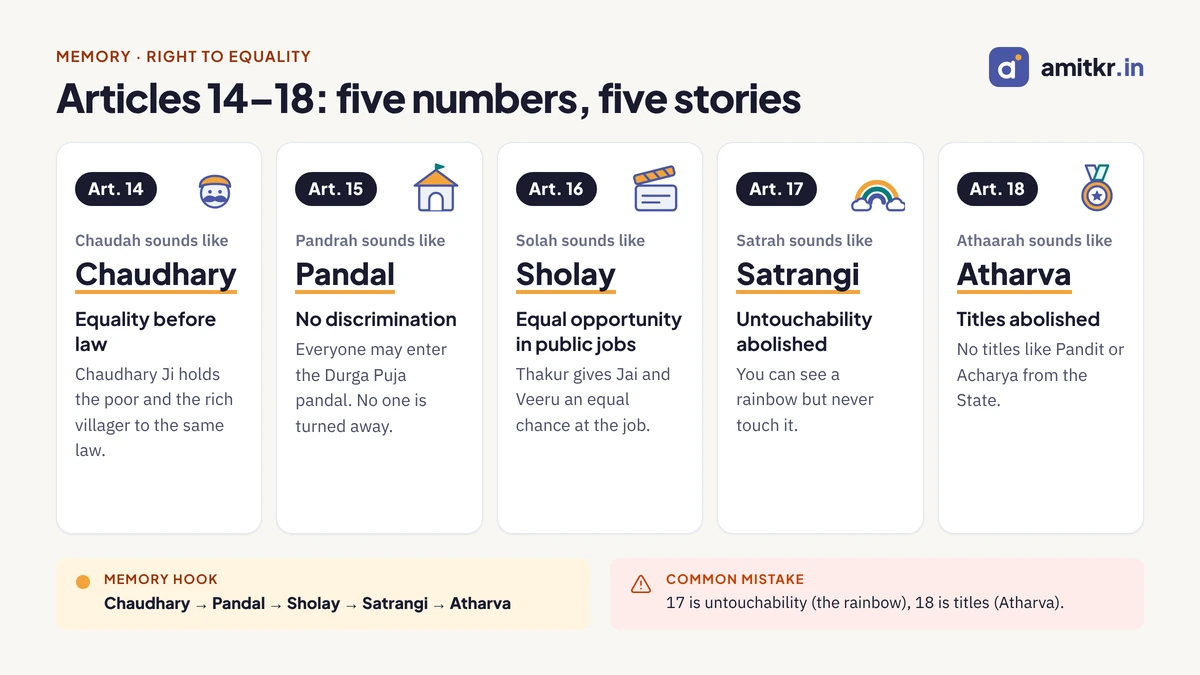
Article 14: Equality before law (Chaudah → Chaudhary)
Article 14 guarantees equality before law and equal protection of laws.
MEMORY HOOK
Chaudah sounds like Chaudhary. Imagine – Chaudhary Ji, a Mukhiya (village chief) with a big moustache, is sitting in his Panchayat office, hearing a dispute between two villagers – one is poor, the other rich. Both are standing before Chaudhary Ji. He gives both parties equal treatment and holds both to the same law.
Article 15: No discrimination (Pandrah → Pandal)
Article 15 prohibits discrimination on grounds of religion, race, caste, sex or place of birth.
MEMORY HOOK
Pandrah sounds like Pandal (Pooja Pandal). During Durga Puja, people come from far away to see the Pandals. Everyone is allowed in. No person is discriminated against.
Article 16: Equal opportunity in public employment (Solah → Sholay)
Article 16 guarantees equality of opportunity in matters of public employment.
MEMORY HOOK
Solah sounds like Sholay (the movie). In the movie, Thakur wants to hire someone for an important job: capturing Gabbar Singh. He announces the vacancy. Both Jai and Veeru apply for the job. Thakur gives both an equal opportunity to get selected. He doesn’t discriminate between them.
Article 17: Abolition of Untouchability (Satrah → Satrangi)
Article 17 abolishes untouchability and forbids its practice in any form.
MEMORY HOOK
Satrah sounds like Satrangi (rainbow). You can see and admire a Satrangi, but you cannot touch it. A Satrangi is untouchable. Article 17 changes that by abolishing untouchability.
Article 18: Abolition of titles (Athaarah → Atharva)
Article 18 abolishes titles. The State cannot confer titles, except military and academic distinctions.
MEMORY HOOK
Athaarah sounds like Atharva (from Atharvaveda). Atharva means a priest, and priests are often addressed with titles like Pandit, Acharya or Father. Article 18 abolishes the use of such titles.
Quick recap
Say it once, without looking: Chaudhary → Pandal → Sholay → Satrangi → Atharva. Equality before law, no discrimination, equal opportunity in jobs, no untouchability, no titles. That is the complete Right to Equality.
Worked Example 2: Right to Freedom (Articles 19–22)
The Right to Freedom covers Articles 19 to 22. It protects what you can do (speak, move, work) and protects you when the State acts against you. The stories here are a little longer, because Articles 19 and 20 pack many points into one article.
Article 19: Six freedoms (Unnees → Uni)
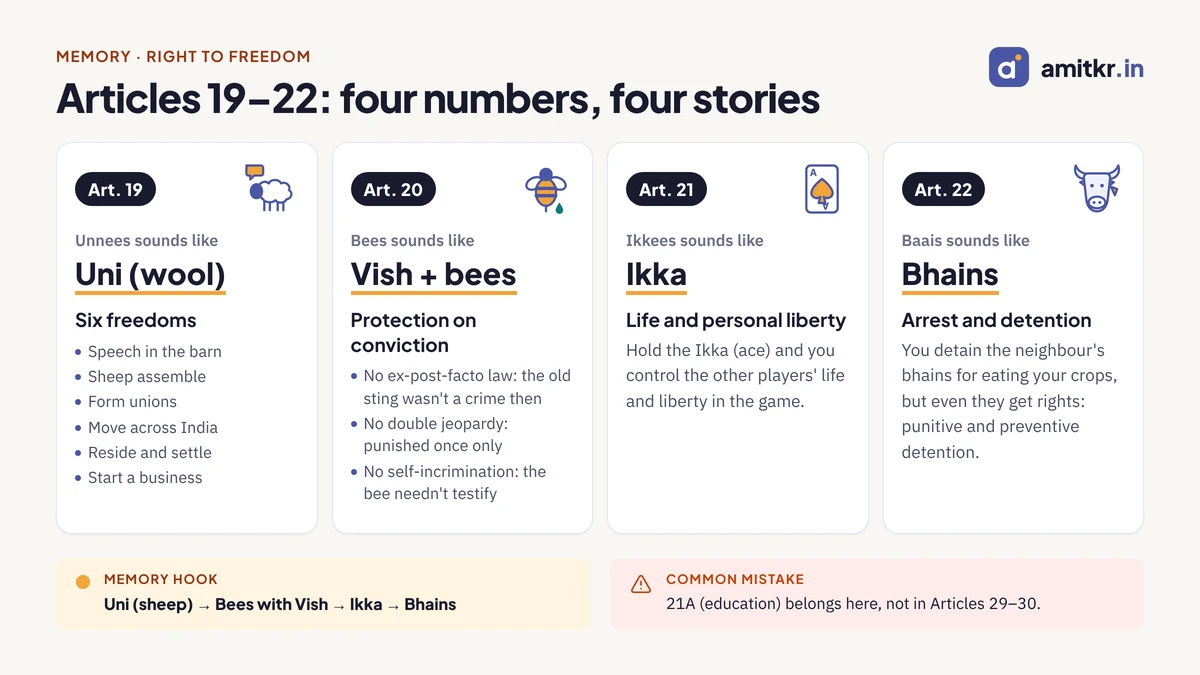
Article 19 protects six freedoms of citizens: speech and expression, peaceful assembly, forming associations or unions, free movement throughout India, residing and settling anywhere in India, and practising any profession or business.
MEMORY HOOK
Unnees sounds like Uni, as in Uni-kapda (woollen clothes). Wool comes from sheep. Imagine a barn full of sheep. One ambitious sheep decides to take over the wool business. He stands tall in the middle of the barn and delivers a speech about his plan. All the sheep assemble around him. They plan to form unions and travel (move freely) to different states throughout India. They will reside and settle in suitable places and set up their business there.
Count the bold words: speech, assemble, unions, move, reside and settle, business. That is all six freedoms, in one barn.
Article 20: Protection in respect of conviction for offences (Bees → Vish and Bees)
Article 20 gives three protections to a person accused of an offence: no ex-post-facto law, no double jeopardy, and no self-incrimination.
MEMORY HOOK
Bees sounds like Vish (Hindi for venom), and also like bees, the insects. Imagine a bee stings you. When a bee stings, it injects Vish into your body, and that is an offence. Long ago, a bee had also stung one of your friends, at a time when stinging and injecting Vish was not an offence.
Now the three protections:
- No ex-post-facto law: The bee that stung you can be punished, because stinging is an offence now. But the bee that stung your friend long ago cannot be punished, because it was not an offence at that time.
- No double jeopardy: Once the bee that stung you has been convicted and punished, it cannot be prosecuted and punished again for the same sting.
- No self-incrimination: You cannot force the bee to testify against itself.
Article 21: Protection of life and personal liberty (Ikkees → Ikka)
Article 21 says no person shall be deprived of life or personal liberty except according to procedure established by law.
MEMORY HOOK
Ikkees sounds like Ikka (the ace card). In card games, if you hold the Ikka, you have an advantage over the other players. In a sense, you control their life and liberty in the game.
Note: Article 21A (Right to Education, for children aged 6 to 14) sits right next to Article 21. Its memory hook is in the complete FR Memory Kit.
Article 22: Protection against arrest and detention (Baais → Bhains)
Article 22 gives rights to persons who are arrested or detained, under both punitive and preventive detention.
MEMORY HOOK
Baais sounds like Bhains (buffalo). Imagine your neighbour’s bhains keep entering your fields, trampling and eating your crops. You are so annoyed by these repeated visits that you decide to arrest and detain some of the bhains. Article 22 gives some rights to those arrested and detained bhains, in both cases: punitive detention and preventive detention.
Quick recap
Say it once more: Uni (sheep in the barn) → Bees with Vish → Ikka → Bhains. Six freedoms, protection on conviction, life and liberty, arrest and detention. That is the Right to Freedom.
What About the Other Articles (12, 13 and 23–35)?
The same method works for every article in Part III. You have now seen it for nine articles. The rest follow exactly the same three steps: Hindi number, sound-alike word, small story.
Here is what is left:
- The four remaining rights: Right against Exploitation (23–24), Right to Freedom of Religion (25–28), Cultural and Educational Rights (29–30) and Right to Constitutional Remedies (32).
- The opening articles: Article 12 defines “the State”, and Article 13 makes any law that violates Fundamental Rights void.
- The closing articles: Article 33 lets Parliament modify these rights for the armed forces, Article 34 restricts them while martial law is in force, and Article 35 gives Parliament the power to make laws on them.
- The missing number: Article 31 (Right to Property) was repealed by the 44th Amendment in 1978.
Read the official text of Part III on legislative.gov.in
COMING SOON
The FR Memory Kit
I am putting memory hooks for ALL the articles, from 12 to 35, into one kit:
- A story for every article, including 21A, 31A–C and 32
- A one-page revision sheet for all six rights
- A self-test to check yourself on day 1, 3, 7, 16 and 30
Get the free toolkit below, and you will be the first to know when it is out.
Fundamental Rights in UPSC and BPSC Prelims
Prelims rarely asks “What is Article 14?” directly. It mixes the right numbers with wrong details in statement-type questions. This is where your stories help, because each story carries both the number AND the details.
EXAM ANGLE
Try this practice question (written for this post). Consider the following statements:
- Article 17 abolishes untouchability.
- Article 18 prohibits the State from conferring military distinctions.
- Protection against double jeopardy is provided under Article 20.
Which of the statements given above are correct?
(a) 1 and 2 only
(b) 1 and 3 only
(c) 2 and 3 only
(d) 1, 2 and 3
Solve it with the stories:
- Statement 1: Satrah → Satrangi, the rainbow you cannot touch. Article 17 is untouchability. Correct.
- Statement 2: Athaarah → Atharva, titles like Pandit and Acharya. Article 18 abolishes titles, but military and academic distinctions are allowed. Wrong.
- Statement 3: Bees → the bee with Vish, punished once, never twice. Article 20 is double jeopardy. Correct.
Answer: (b) 1 and 3 only.
Common Mistakes Aspirants Make
COMMON MISTAKES
- Confusing Article 12 with Article 14. Article 12 only defines “the State”. Equality before law is Article 14 (the Chaudhary).
- Counting seven Fundamental Rights. The Right to Property (Article 31) was removed in 1978. There are six.
- Putting Article 21A under Cultural and Educational Rights. The Right to Education is Article 21A, part of the Right to Freedom, not Articles 29–30.
- Mixing up 17 and 18. Untouchability is the rainbow (Satrangi, 17). Titles are the priest (Atharva, 18).
Test Yourself: Fundamental Rights Quiz
Don’t scroll up. Try to answer each question first, then open it to check.
How many Fundamental Rights are there in the Indian Constitution?
Six. They are in Part III of the Constitution, Articles 12 to 35.
Which article abolishes untouchability?
Article 17 abolishes untouchability. Remember the Satrangi you cannot touch.
Which article guarantees equal opportunity in public employment?
Article 16 guarantees equality of opportunity in public employment. Remember Thakur giving both Jai and Veeru an equal chance at the job in Sholay.
Which article protects the six freedoms of speech, assembly, association, movement, residence and profession?
Article 19 protects these six freedoms. Remember the sheep in the barn.
Which article protects against double jeopardy and self-incrimination?
Article 20 protects against ex-post-facto laws, double jeopardy and self-incrimination. Remember the bee with Vish.
Why is the Right to Property no longer a Fundamental Right?
The 44th Amendment (1978) removed it from Part III. It is now a legal right under Article 300A.
How many did you get right? If you got all six, revise them once more tomorrow. If you missed one, go back to its story and SEE the scene again.
Now, it’s your turn! Try the method on Articles 23 and 24 (Right against Exploitation). Make your own stories. The more personal a story is, the longer it stays.
See you in the next one.
Get the free Memory + AI Study Toolkit
A memory techniques cheat sheet, 25 AI study prompts, a one-page note template, a revision tracker and a weekly planner. One printable PDF, free.